


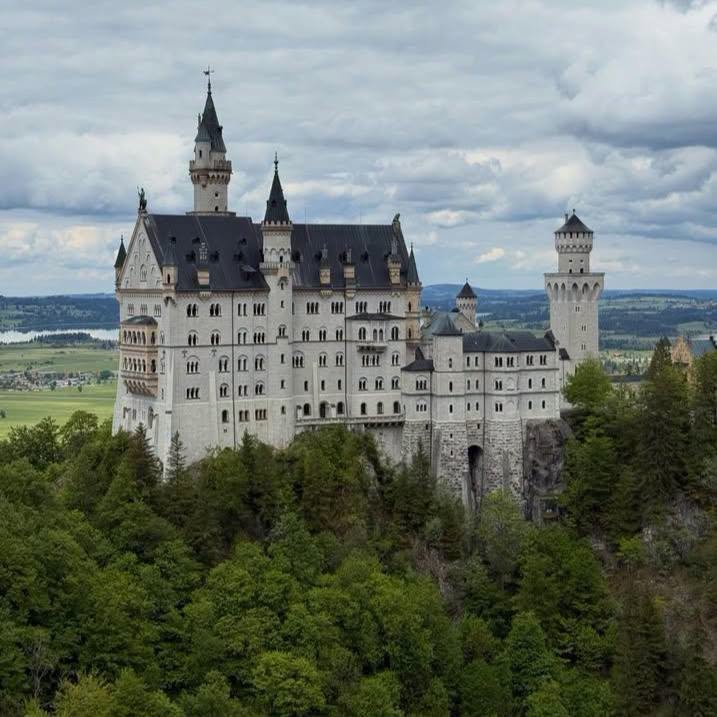
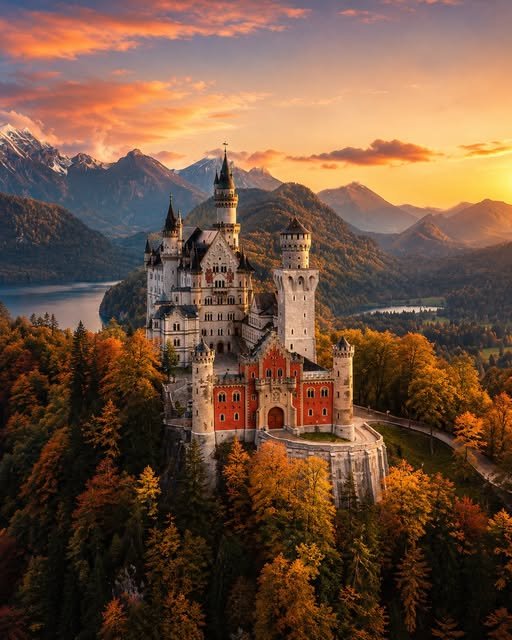
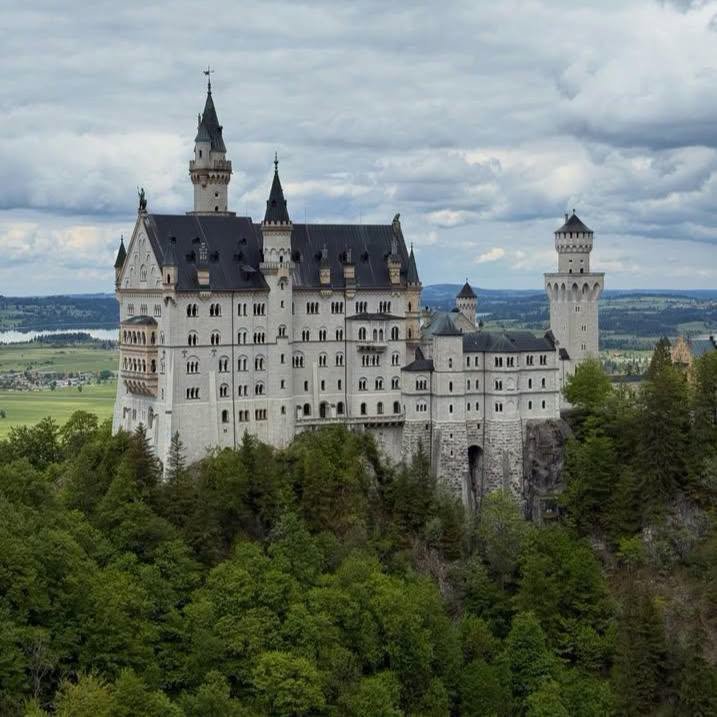
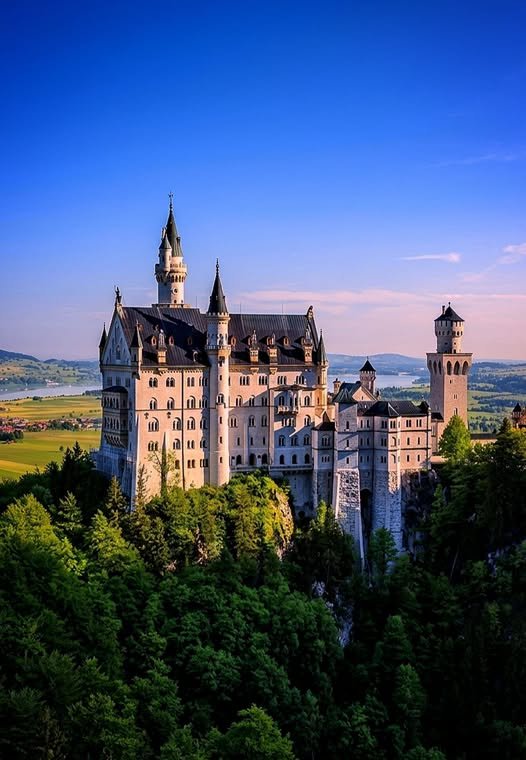
Neuschwanstein Castle is one of Germany’s most recognizable landmarks, rising dramatically above the village of Hohenschwangau near Füssen in southwestern Bavaria. With its soaring towers, pale limestone walls, steep roofs, and spectacular Alpine setting, the castle looks medieval—but it was actually created in the 19th century. Its story is closely connected with King Ludwig II of Bavaria, his fascination with medieval legends, and his deep admiration for the composer Richard Wagner.
The Landscape Before Neuschwanstein
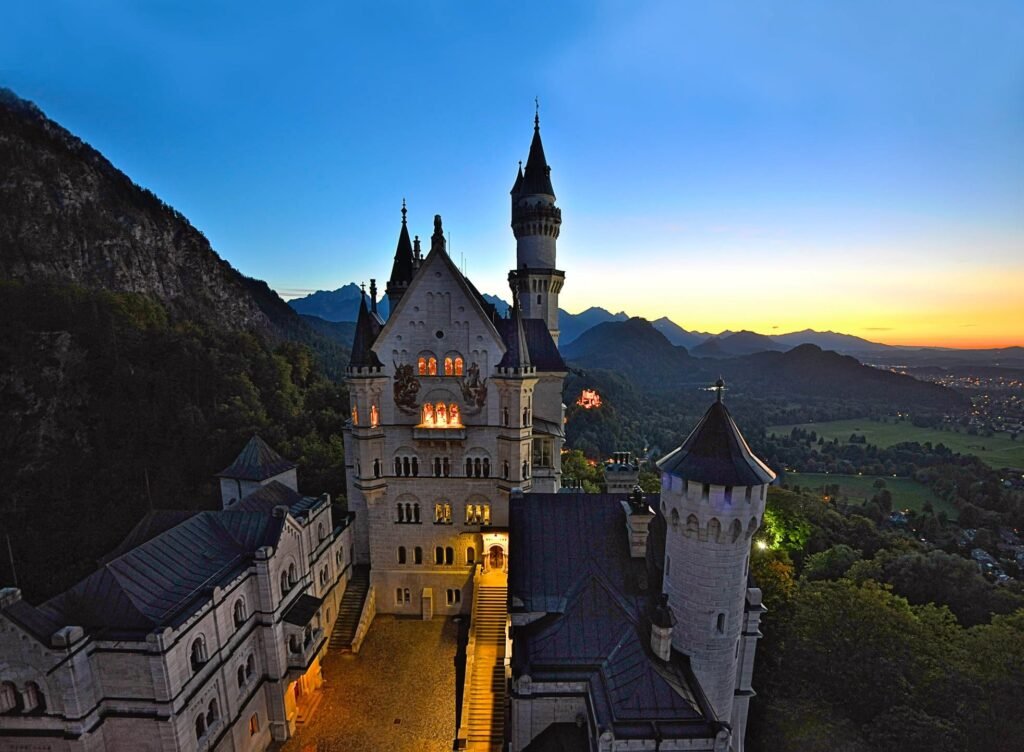
The rugged hill on which Neuschwanstein stands was already associated with castles long before Ludwig II began his project. Two medieval fortresses, Vorderhohenschwangau and Hinterhohenschwangau, once occupied the area.
By Ludwig’s childhood, the medieval structures had largely fallen into ruins. His father, King Maximilian II of Bavaria, transformed the surviving Hohenschwangau Castle nearby into a romantic Neo-Gothic residence during the 1830s and 1840s.
Ludwig grew up surrounded by Alpine scenery, legends, medieval architecture, and romantic literature. These influences later became central to his vision for Neuschwanstein.
Ludwig II and His Vision
Ludwig II became King of Bavaria in 1864 at only 18 years old. Although his reign was politically complicated, he developed a strong personal interest in art, architecture, mythology, and music.
One of the most important figures in his artistic world was Richard Wagner. Ludwig greatly admired Wagner’s operas, particularly their themes of medieval heroes, Germanic legends, knights, kings, and mythical worlds.
After becoming king, Ludwig supported Wagner financially and personally. Their relationship had a major influence on Ludwig’s architectural ambitions.
Neuschwanstein was conceived partly as a monument to the medieval world depicted in Wagner’s works and partly as a private refuge where Ludwig could escape the pressures of royal and political life.
The Beginning of Construction
The decisive moment came in 1868, when Ludwig ordered the construction of a new castle above Hohenschwangau.
The project originally had a different character from the building visitors see today. Ludwig wanted a spectacular medieval-inspired residence, but he did not intend to create a historically accurate reconstruction of a medieval castle.
Instead, he wanted an idealized vision of the Middle Ages—a place combining Romanesque architecture, Gothic influences, legends, theater, music, and romantic imagination.
Architectural planning involved several designers, most notably Eduard Riedel, while the stage designer Christian Jank produced influential early drawings. Ludwig was deeply involved in the project and repeatedly changed plans according to his artistic ideas.
The foundation stone was laid on September 5, 1869.
A Castle Designed Like a Romantic Dream
Neuschwanstein’s architecture is often described as Romanesque Revival, although the building incorporates several medieval styles.
Its towers, turrets, balconies, arches, courtyards, and steep roofs create the appearance of an idealized medieval fortress. Yet the interior included many modern 19th-century conveniences.
The castle was therefore not simply an imitation of an old fortress. It was a theatrical and artistic interpretation of medieval life.
Ludwig wanted the building to tell stories through its rooms and decorations. Paintings and murals were inspired by medieval legends, Germanic mythology, Christian traditions, and stories connected with Wagner’s operas.
Richard Wagner’s Influence
Although Wagner never lived at Neuschwanstein and the composer died before the castle was completed, his influence is visible throughout the building.
Ludwig admired Wagner’s ability to combine music, poetry, mythology, drama, and visual spectacle. The castle was intended to provide a physical setting for the same romantic world that appeared in Wagner’s operas.
The throne room, singers’ hall, private apartments, and other spaces were decorated with imagery drawn from heroic legends and medieval stories.
The castle’s name itself, Neuschwanstein, can be translated approximately as “New Swan Stone.” The swan was particularly meaningful to Ludwig and Wagner, appearing prominently in the legend of Lohengrin, one of Wagner’s major works.
The Interior
Although the exterior resembles a medieval fortress, the interior demonstrates the technological sophistication of the late 19th century.
Ludwig’s private rooms contained modern systems for heating, water supply, and sanitation. The king’s bedroom included elaborate woodcarving, while other rooms were decorated with richly painted scenes and symbolic imagery.
The Throne Room was planned on a grand scale and was inspired by Byzantine and Christian artistic traditions. Interestingly, despite its name, the room was never completed with a throne.
The Singers’ Hall was another important space. It was influenced by medieval traditions surrounding courtly music and legendary singers and was closely connected with Ludwig’s fascination with Wagner’s artistic world.
Ludwig II’s Private Retreat
Ludwig never intended Neuschwanstein to function primarily as a government palace.
He wanted it to be a private sanctuary. The king increasingly withdrew from public life and preferred spending time in his imaginative world of castles, legends, literature, and music.
Neuschwanstein was therefore designed around Ludwig’s personal tastes rather than the practical needs of a working royal court.
Construction continued for years, but the project repeatedly expanded. Ludwig’s increasingly ambitious plans contributed to rising costs and delays.
Bavaria’s Political Changes
While Ludwig concentrated on architecture and artistic projects, Bavaria was experiencing enormous political change.
In 1871, the German Empire was established under Prussian leadership. Bavaria retained its king and certain special privileges, but much of its political independence was reduced.
Ludwig’s role increasingly became symbolic rather than that of an independent sovereign with complete political power.
As his personal spending increased and his isolation from government affairs became more pronounced, concerns about his leadership grew among members of the Bavarian government.
The Unfinished Castle
Despite more than a decade of construction, Neuschwanstein remained incomplete.
Ludwig moved into the castle in 1884, even though large portions of the building were still unfinished.
He lived there only for a relatively short period.
The king’s plans had become extraordinarily ambitious, and construction continued even as his financial situation became increasingly difficult.
Several rooms and architectural features that Ludwig had imagined were never completed.
The Downfall of Ludwig II
By the middle of the 1880s, Ludwig’s relationship with the Bavarian government had deteriorated severely.
In 1886, a medical commission declared him mentally incapable of governing. The exact circumstances surrounding his removal remain the subject of historical discussion.
Ludwig was removed from power and taken to Berg Castle near Lake Starnberg.
On June 13, 1886, Ludwig II and psychiatrist Dr. Bernhard von Gudden were found dead in the shallow waters of Lake Starnberg.
The circumstances of their deaths remain controversial. The official explanation was drowning, but many aspects of the event have continued to generate debate among historians.
Ludwig was only 40 years old.
Neuschwanstein Opens to the Public
Ludwig had imagined Neuschwanstein as a private retreat, but after his death the castle quickly became a tourist attraction.
Only a few weeks after his death, the unfinished palace was opened to visitors.
The decision transformed the castle’s purpose. What had been created as a secluded personal sanctuary became one of Bavaria’s most famous tourist destinations.
Construction stopped after Ludwig’s death, leaving several planned sections unfinished.
The castle that visitors see today is therefore not exactly the building Ludwig originally envisioned. It represents a partially completed version of his enormous architectural dream.
Neuschwanstein During the 20th Century
Neuschwanstein survived the political upheavals of the 20th century remarkably well.
During World War II, the castle was used by the Nazi regime as a storage location for artworks and cultural objects stolen from occupied territories. The remote location made it useful for concealing valuable collections.
As Allied forces advanced toward Germany near the end of the war, efforts were made to prevent the destruction or removal of the stored treasures.
After the war, Neuschwanstein survived and eventually returned to its role as a major cultural and tourist attraction.
Influence on Popular Culture
The castle’s extraordinary appearance helped transform it into a global symbol of fairytale Europe.
Its towers rising above forests and mountains created an image that seemed almost unreal. The dramatic setting and romantic architecture inspired artists, photographers, filmmakers, designers, and storytellers.
Neuschwanstein is particularly famous for its connection with Disney’s visual interpretation of the fairytale castle.
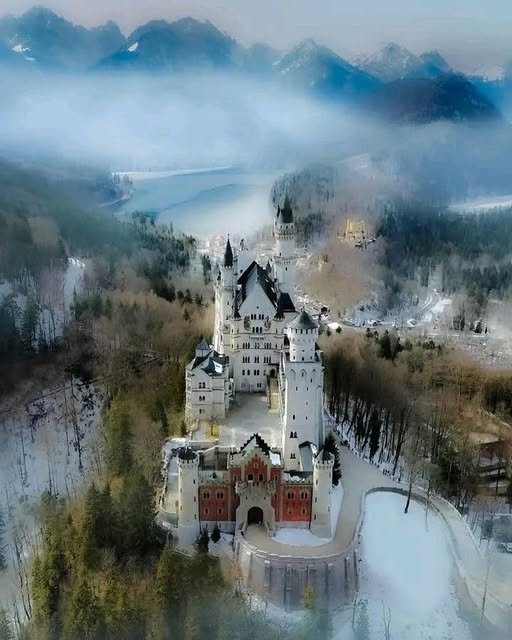
The castle is widely associated with the design language of Disney’s Sleeping Beauty Castle. While Disney’s castle is not a direct architectural copy, Neuschwanstein is commonly cited as an important visual inspiration for the fairytale aesthetic associated with the Disney parks and the animated film.
Neuschwanstein Today
Today, Neuschwanstein is one of Germany’s most visited historic monuments.
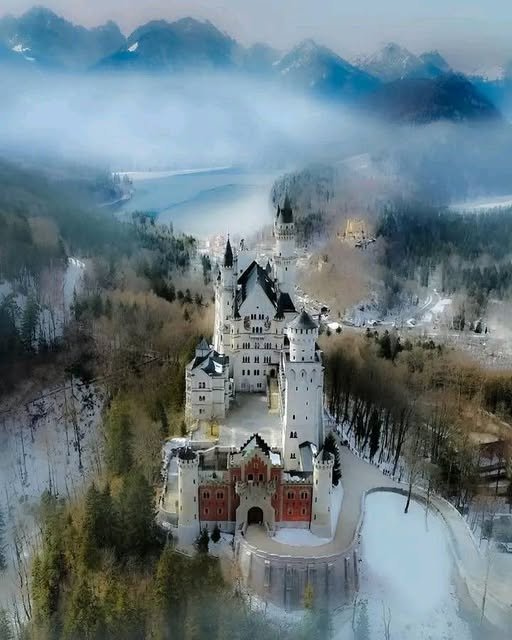
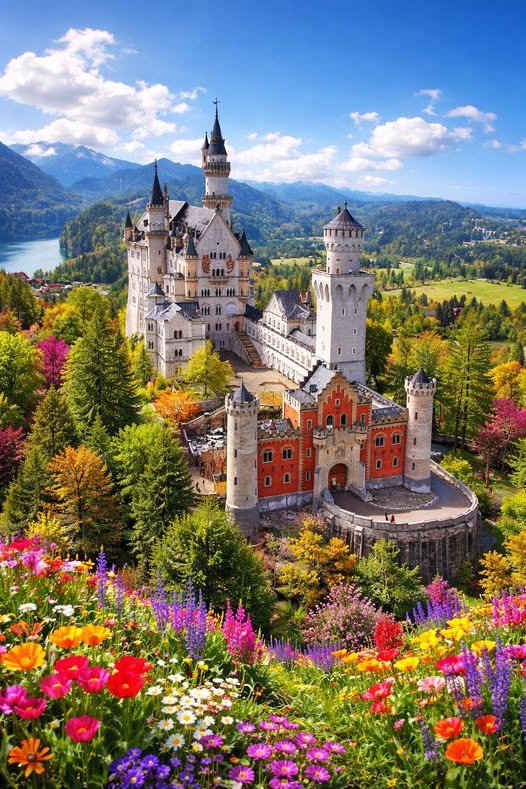
Visitors climb the hill above Hohenschwangau to experience the castle and the spectacular landscape surrounding it. From the area around the castle, there are sweeping views of the Bavarian Alps, forests, valleys, and nearby lakes.
The building remains unfinished in several respects, but this incompleteness has become part of its historical character.
Its importance lies not only in its architecture but also in the story of Ludwig II—the king who attempted to create an idealized world inspired by medieval legends, music, mythology, and romantic imagination.
Historical Significance
Neuschwanstein represents a fascinating moment in European history when the medieval past was being rediscovered through Romanticism.
Rather than reproducing medieval architecture exactly, Ludwig created a fantasy version of the Middle Ages using the technology and artistic techniques of the 19th century.
The castle also illustrates the personality of Ludwig II. He was a monarch fascinated by art and imagination who increasingly preferred private artistic projects to political responsibilities.
His death transformed the meaning of Neuschwanstein. What had been intended as his personal sanctuary became a public monument and eventually an international icon.
Legacy
More than 150 years after construction began, Neuschwanstein remains one of the world’s most recognizable castles.
Its story combines royal ambition, medieval mythology, Romantic architecture, Wagnerian opera, political change, tragedy, and tourism.
The castle’s enduring appeal comes from this combination. It is not a genuine medieval fortress, but something arguably more unusual: a 19th-century king’s dream of what a medieval castle should have looked and felt like.
Perched dramatically above the Bavarian landscape, Neuschwanstein continues to embody Ludwig II’s extraordinary imagination. Today, it stands not merely as a castle, but as a monument to the power of art, fantasy, and architecture to transform a personal dream into a cultural landmark known throughout the world.

