


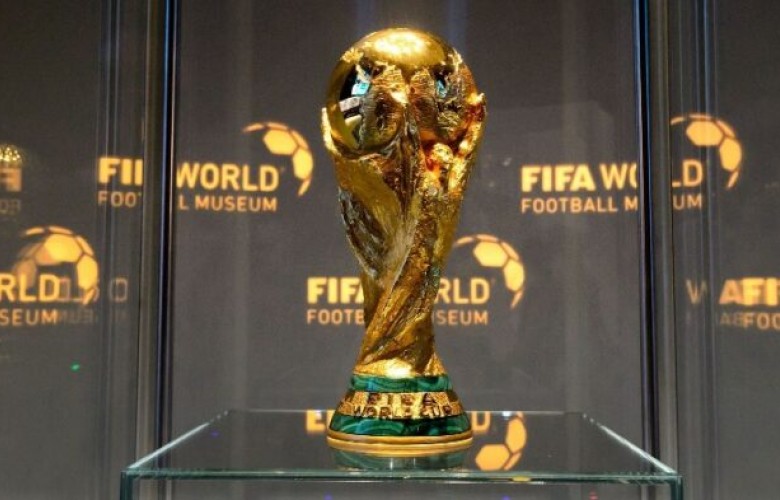
The United States will host the 2026 World Cup together with Canada and Mexico. DW explains why this tournament will be different.
1. Three countries as joint hosts
Usually, the FIFA World Cup is hosted by a single nation, but that has not always been the case. The 2002 World Cup set a new precedent when Japan and South Korea—two countries that have not always enjoyed an easy relationship—jointly hosted the tournament. The 2026 World Cup goes even further, with three host nations: the United States, Canada, and Mexico. While these countries have generally maintained good relations, U.S. ties with Canada and Mexico have become strained since the start of President Donald Trump’s second term.
2. More teams, more matches
Love it or hate it, the decision to expand the World Cup from the previous 32 teams to 48 was a bold move by FIFA President Gianni Infantino. More teams mean many more matches—104 in total, compared with 64 at the 2022 World Cup in Qatar. This also means there will be 12 groups of four teams, compared with eight four years ago.
An additional knockout round—the Round of 32—has also been introduced to help reduce the number of teams on the road to the final in New Jersey on July 19. This will be played on the 39th day of the tournament—10 days more than it took to complete the 2022 World Cup.
3. New participants
While critics argue that increasing the number of teams could reduce the overall quality of play, it has also helped several countries qualify for a World Cup for the first time in history. Cape Verde, Curaçao, Jordan, and Uzbekistan will make their debut on football’s biggest stage. Of these, Curaçao are the lowest-ranked, coming from a country with a population of under 160,000 and ranked 82nd in the world.
Several others could also qualify for the first time through playoff matches in March—including North Macedonia, Albania, Kosovo, and even New Caledonia.
4. More travel
This is not the first time a World Cup will be held across a large geographical area, but the distances teams and fans will have to travel in 2026 will come as a shock after Qatar, which is smaller than Connecticut—the third-smallest state in the United States.
The two farthest host cities apart are Vancouver and Miami—4,507 kilometers (2,800 miles). Germany are expected to travel 2,619 kilometers just to move from Houston to Toronto and on to New Jersey for their group-stage matches—without even counting travel to and from their base camp, the location of which has yet to be announced.
5. Mandatory breaks
While drink breaks are not new in football, FIFA has announced that all matches at the 2026 World Cup will feature two scheduled breaks—regardless of weather conditions.
Referees will be instructed to stop matches 22 minutes into each half so players can take drinks, FIFA said in a statement. Previously, referees were required to introduce cooling breaks 30 minutes into each half only when the temperature at kickoff exceeded 31 degrees Celsius. The change comes amid concerns over high temperatures expected in some host cities, as seen at last summer’s Club World Cup. FIFA said it took this into account when determining kick-off times.
6. Not all fans are welcome
Two countries that have qualified for the World Cup, Iran and Haiti, are subject to a travel ban announced by U.S. President Trump last June. This means that, as things currently stand, their fans will not be able to travel to the United States to support their teams. The teams themselves, however, should not have any issues entering the U.S., as Trump’s executive order makes exceptions for “any athlete or member of an athletic team, including coaches, persons performing a necessary support role, and immediate family members, traveling for the World Cup, the Olympic Games, or any other major sporting event as determined by the Secretary of State.”
Where the matches will actually be played remains unclear, as Trump has repeatedly threatened to move World Cup games away from Democrat-led cities for “security” reasons. During a meeting at the White House in November, Infantino offered no specific response. “Safety and security are the number one priority for a successful World Cup,” he said.

