


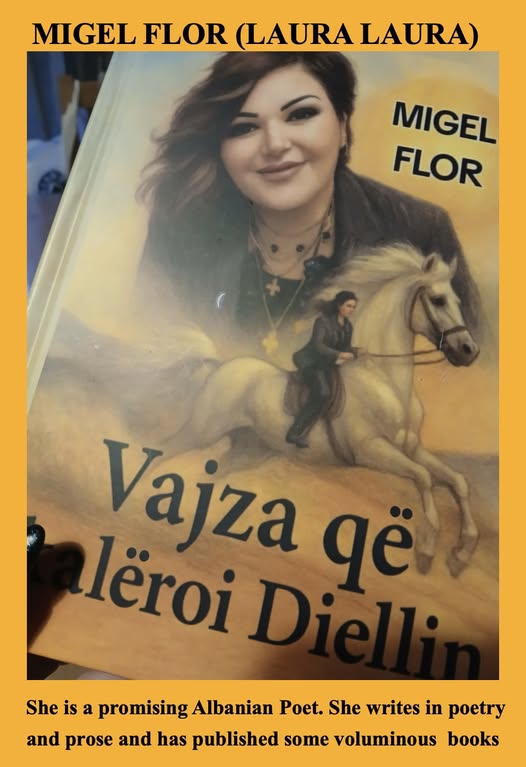
THE CHAM GIRL
In her eyes, the Ionian Sea sleeps,
which washes the shores of Chameria,
as blue as the legacy of the ancestors,
with waves that do not speak,
yet hold histories.
She walks upon stones of memory,
in a dress embroidered with longing,
like a spring that blossoms
upon wounded land.
In her hair, the coastal breeze blows,
carrying the scent of olive and orange,
and every step she takes
is a silent prayer for return.
The Cham girl does not weep aloud,
she bears her pain like an ornament,
wears it around her neck like a string of coral,
not sold for any world.
In her smile
there is light from homes left behind,
there are doors that wait
and thresholds that do not forget.
She is an unsung song,
she is a dance beneath the moon,
she is a heart that beats strongly
even when history tries to silence it.
The Cham girl,
daughter of a land that never surrendered,
blooms like violets on stone
and carries her name
like a flag in her soul.
By Migel Flor
A SHORT VIEW OF THE POEM ”THE CHAM GIRL”
OF THE AUTHOR MIGEL FLOR
The poem “The Cham Girl” is a powerful and lyrical tribute to the resilience, identity, and enduring sorrow of the Cham Albanian people who were expelled from their homeland of Chameria (in modern-day northwestern Greece) after World War II.
The girl of the poem is not just an individual but a symbol of her people. The “Ionian Sea” in her eyes and the “shores of Chameria” in her gaze show that the homeland is an intrinsic part of her identity, carried within her even in exile. The land is alive in her memory, her dress, her scent, and her steps.
The poem emphasizes quiet endurance. She does “not weep aloud”; instead, she bears her pain “like an ornament,” something precious and inseparable from her identity. This pain is not for sale—it cannot be traded or forgotten for any material comfort. Her struggle is dignified and deeply personal.
Longing and Unbroken Hope for Return take a large space in the poem. Every step is “a silent prayer for return.” Her smile contains “light from homes left behind,” and references to waiting doors and unforgettable thresholds reinforce the idea that the displacement is not accepted as permanent. The hope to go back is a quiet, persistent flame.
The poem demonstrates the Identity as Resistance. The Cham girl is “an unsung song,” “a dance beneath the moon”—her culture and identity persist even without recognition. She is the “daughter of a land that never surrendered.” By carrying her name “like a flag in her soul,” she embodies resistance against historical erasure. History tries to “silence” her heart, but it continues to beat strongly.
Looking at the poem, it is clear that the poet features, with mastery, the beauty and the resilience even in hardship.
The poet uses natural, beautiful imagery to describe her resilience: she is “like a spring that blossoms upon wounded land” and “blooms like violets on stone.” This shows how life, beauty, and strength can persist in the most difficult circumstances, rooted in memory and identity.
In essence, the poet clearly and masterfully demonstrates that the Cham girl—and, by extension, the Cham people—carries the legacy of a traumatic history with grace and strength. She embodies the undying memory of Chameria, the quiet refusal to forget, and the unyielding hope for justice and return. The poem is both an elegy for a lost homeland and a celebration of the unbroken spirit.
(By Kujtim Hajdari)

