


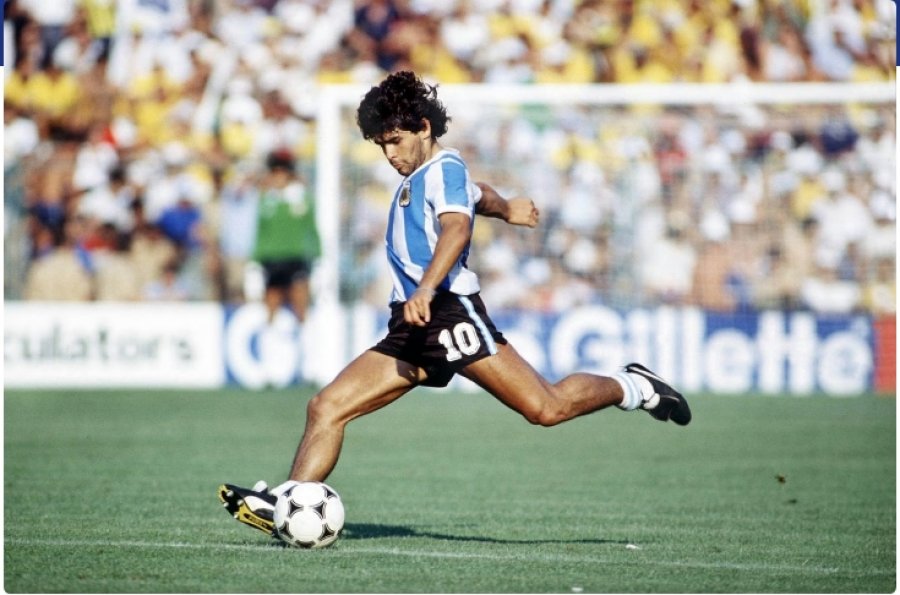
He is regarded as a football deity, five years after the death of Diego Armando Maradona. Maradona led Argentina to the World Cup title in 1986, the peak of his extraordinary career.
Diego Armando Maradona was born on October 30, 1960. He grew up in the poor neighborhood of Villa Fiorito on the outskirts of Buenos Aires. “It rained more inside than outside,” he once said about his first home. The whole family lived in three rooms, without running water: Old Diego and Tota, young Diego, his four older sisters, and three younger siblings.
From childhood, he played football in the streets, and a modest upbringing full of challenges shaped his fighting spirit and playing style.
Maradona led Argentina to the World Cup title in 1986, the highlight of his remarkable career.
Throughout his career, he played for Argentinos Juniors, Boca Juniors, Barcelona, Napoli – where
“I am very proud to make people happy with football”
“I am very proud to make people happy through football. I feel that I have given joy and entertainment to those who watched me in the stadiums or on television,” Diego Armando Maradona once said, the man who became a symbol of world football.
Although regarded as one of the greatest footballers the world has ever seen, his path was far from easy. Obstacles, scandals, and personal problems often threatened to tarnish his legacy forever. But as Maradona himself said: “The ball cannot be stained.” Despite strange behaviors and struggles with alcohol and drugs, he remained an extraordinary and fascinating figure in football history.
His former teammate Hugo Perotti described him: “His talent and wild lifestyle followed him from an early age. It simply couldn’t have ended any other way.”
The rise of a star
Maradona’s talent was evident from childhood. Guided by his uncle Cirilo, a former goalkeeper, he quickly stood out for his extraordinary skills. Francisco Cornejo, the first scout to notice him at Argentinos Juniors, said:
“Everything he could do with the ball… the ball just stuck to Diego.”
At just 15, he debuted for Argentinos Juniors, becoming the youngest player ever in Primera. At 16, he made his debut for the national team in a friendly against Hungary, and at 19 he was named South America’s best player for the first time.
After five brilliant years, he transferred to Boca Juniors, scoring 28 goals in 40 matches and leading the team to the Primera title. Yet he stayed only one season, as Barcelona paid a then-record fee to sign him.
Napoli – where he became a legend
After two seasons at Barcelona, Maradona moved to Napoli for another world-record fee. Hundreds of thousands of fans welcomed him as a savior. In a city plagued by poverty and shortages, his arrival brought hope and pride.
With Napoli, he won:
- two Italian league titles
- the UEFA Cup
- the Italian Cup
- the Supercup
In Naples, he was worshiped like a deity but also became a victim of his own success. Despite his achievements on the field, his personal life worsened, culminating in a 15-month suspension in 1991 for cocaine use.
The final chapters and coaching career
After the suspension, he played for Sevilla, Newell’s Old Boys, and returned to Boca Juniors, where he ended his playing career. With Argentina, he scored 34 goals in 91 appearances, though the 1994 World Cup was marred by a positive doping test.
As a coach, he did not achieve the same success as he did as a player. He managed several teams, including Argentina from 2008 to 2010, but results did not match the legendary level he had reached on the pitch.
Legacy
Diego Armando Maradona passed away on November 25, 2020, from a heart attack. Despite a tumultuous life and frequent criticism, his impact on football remains unparalleled.
As Michel Platini once said:
“The things I could do with the ball, he could do with an orange.”
Maradona remains a figure beyond sport: a rebellious genius, a popular icon, and a legend who continues to live in the hearts of fans.

